
You bought an apartment in a new building, start planning renovations, and suddenly realize that there is a concrete column sticking out in the middle of the room. Neither against the wall nor in the corner — just in the middle of the space. The first reaction of most people is: "This needs to be removed." We tell you why this is not possible, what can actually be done, and how a column can become one of the most beautiful details of your interior.
To understand how to work with it, you first need to understand why it exists. Modern residential buildings in Lviv and throughout Ukraine are mostly built using monolithic-frame technology. This means that the building is supported not by walls, but by a spatial reinforced concrete frame: columns + floors + beams. The walls in such a house are just partitions, they do not carry anything.
Columns are vertical elements that receive and transfer loads from all floors down to the foundation. They are calculated by the designer and are spaced at a certain distance along the entire building plan. No one deliberately «crammed» a column into your living room — the frame mesh just ended up there.
Short answer: No. A column is a load-bearing structure that holds everything above it. To demolish it means to violate the integrity of the building frame. This is not just technically prohibited — it is dangerous for the entire building, and no approval will allow this.
Therefore, all solutions lie in a different plane: not "how to remove", but "how to make the column become part of the interior, and not an obstacle.".
And here the most interesting thing begins.
A column is a vertical dominant in space. If you don't fight it, but accept it as an element, it can really decorate an apartment. Here are the approaches we use on objects.
Give it the correct shape. A typical reinforced concrete column is rectangular or square in cross-section. But there is nothing stopping it from being made round, oval or multifaceted using plasterboard or metal trim. A round column is perceived softer, it "cuts" the space less and looks much more elegant.
Textured or decorative coating. The column can be decorated with decorative plaster, microcement, veneer, stones, or simply painted in the color of the walls, and it will be almost invisible. And if you make an accent color or texture that differs from the walls, on the contrary, it can be turned into an art object.
Integrate into furniture or zoning. A column can be built into a shelf, cabinet, kitchen island, or bar counter. It becomes part of the functional element and ceases to be perceived as superfluous. This is one of the most elegant techniques in apartment planning with columns.
Backlight. Spot or linear lighting around the base or top of the column - and it looks like a design solution, not a structural element.
Zoning by space. If a column is placed between the living room and the kitchen or hallway, it can be used as a natural zone divider. This is a smart and beautiful solution that does not require any additional partitions.
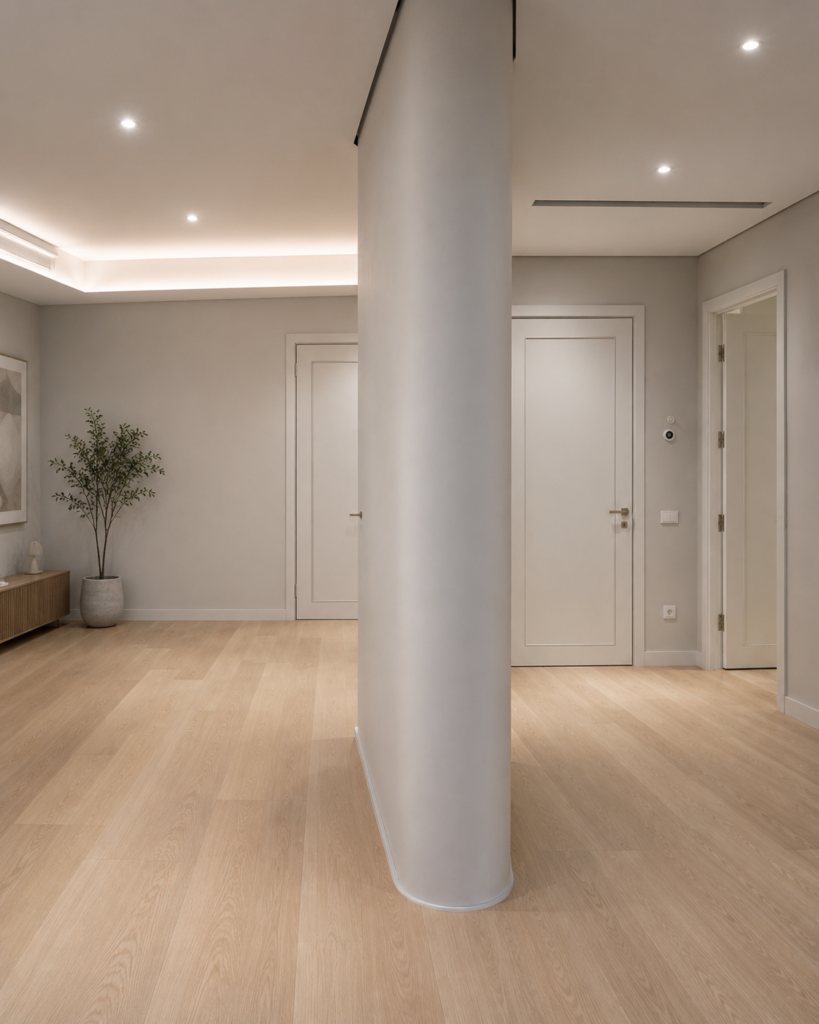
In one of our projects in Lviv in the Tiffany residential complex, the client received an apartment in a monolithic building with a massive rectangular column in the middle of the open space of the room. The task was to make sure that it did not spoil the picture.
We made a plasterboard frame, gave the column a rounded shape, applied decorative plaster to match the walls, and left a smooth matte finish. The result is that the column becomes a neat, almost sculptural element of the space. It exists, but it is organic.
Combined with LED lighting in the ceiling and hidden doors in the same room, it all looks like a thoughtfully designed space.
Before starting any column decoration, it's worth making sure of a few things.
First, clarify the exact size and location of the column in the project documentation or with the developer - sometimes a larger structure is hidden behind the drywall in an already renovated apartment than it seems.
Secondly, if you plan to do a plastering that increases the diameter of the column, calculate how this will affect the arrangement of furniture. Sometimes it is better to leave the column thin and neat than to hide it behind a massive box.
Thirdly, all work on cladding and decorating load-bearing structures is carried out only using methods that do not touch the column itself - no deep drilling, no loosening of the reinforcement.
A column in a monolithic apartment is not an architect's mistake or a planning flaw. It is a constructive necessity that can and should be worked with. With the right approach, it ceases to be a problem and becomes a detail that distinguishes your interior among hundreds of typical apartments.
If you have a column and you don't know what to do with it, contact DimProBud. We will take a look, measure it, and offer a solution that will suit your space.
Yes, if the column is located close to the wall, it can be included in the partition. But it is important: the partition must not be load-bearing and must not structurally touch the column itself.
The column cannot be removed, but all the non-load-bearing walls around it can be moved freely. A monolithic-frame house is precisely what gives maximum freedom in the intersection and planning of space.
Load-bearing walls in monolithic-frame houses, as a rule, do not exist at all - all walls are partitions. Only columns, floors and beams are load-bearing. But before demolishing any wall - it is mandatory to consult with a designer and obtain permission for redevelopment.